THE MONVÈRA EDIT · PRIVATE INTERIORS
Statement trees
for a living room.
A guide to choosing a botanical focal point around your seating, architecture and the way you use the room.
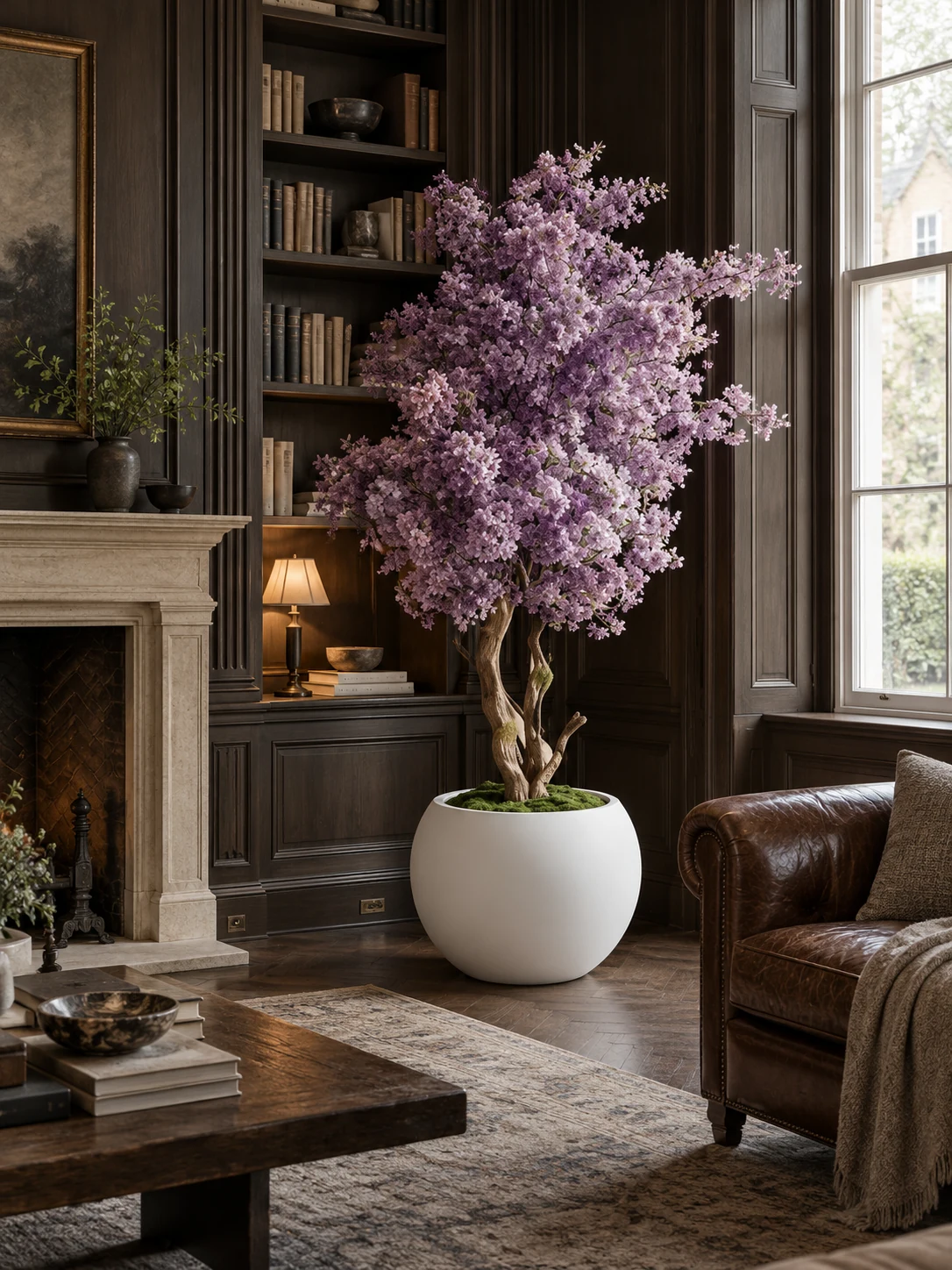
A statement tree can give a living room height and a softer silhouette. The choice becomes clearer when you consider what you want to see from the sofa, how people move through the room and the space available around the canopy.
01 · THE VIEW
Begin where you sit.
Look at the room from your usual seat and from its entrance. An artificial tree beside a sofa may frame the seating area; one further away may draw your eye towards a window or alcove. Check both views before choosing a position.
If the room already has a strong artwork, fireplace or pendant light, leave each piece visual space. An open branching form can feel quieter alongside a detailed interior, while a full flowering canopy can become the room’s main botanical feature.
For luxury home decor, proportion is more useful than simply choosing the largest available tree. The planter, trunk and canopy should be considered as one composition.
02 · THE POSITION
Three ways to place a statement tree.
Beside the seating area.
Place the proposed footprint beside an armchair or at the end of a sofa. Check the canopy at seated head height, the reach of nearby lighting and the route behind the furniture. Keep the arrangement comfortable to walk around.
Within a generous corner.
A corner can give a tall tree a clear background. Measure both walls and check the canopy’s depth as well as its width. A narrow planter does not mean the whole tree has a narrow footprint. Keep foliage away from radiators, fireplaces and other heat sources.
At the edge of an open-plan room.
A tree can mark the transition between a sitting area and another part of the home. Consider how it looks from both sides and keep the walkway clear. A visible natural wood trunk may become part of the composition even when the canopy is viewed across the room.
03 · THE CHARACTER
Blossom, bonsai or olive?
For a more expressive trunk and coral-pink canopy, explore the Collector’s Edition. The taller St Lucia is approximately 300 cm high, so it requires a room with generous ceiling height.
04 · MATERIAL & LIGHT
Consider the planter as part of the room.
Compare the planter finish with your flooring, furniture legs and nearby stone or timber. A pale planter can create a quieter transition against light walls; a darker finish can give the base more definition. The available finish and exact specification need to be agreed for your piece.
Artificial foliage does not need sunlight to grow. Strong sunlight can still affect colour or materials over time, so confirm care and exposure suitability for the chosen design. The collection is intended for indoor use; visualisations do not establish outdoor suitability.
05 · A CONFIDENT CHOICE
Check the space, then the route in.
Measure the floor-to-ceiling height, available canopy width and depth, and the proposed planter footprint. Include light fittings, beams, doors and the position of nearby seating. Our tree sizing guide brings the confirmed collection measurements together.
Before ordering, send your room photographs, measurements and postcode. Include narrow doorways, stairs, tight turns and parking restrictions. We confirm availability, the delivery plan and the complete cost before an order is agreed.
If the collection proportions do not fit your room, a bespoke artificial tree can be discussed around your brief. Custom dimensions and feasibility are confirmed through the quotation process.